A worn finish is usually the first thing you notice about a hardwood floor, long before the wood itself is in trouble. That's where Sue's floor was when she called us in early July: the finish on her pre-finished engineered hardwood was wearing off, and she wanted to know whether the floor could be sanded and refinished instead of torn out.
Sue is a homeowner in Plymouth, Minnesota, and she found us on Google. We put her on the schedule and sent one of our guys out on July 6 to look at the floor and measure. The space worked out to roughly 947 square feet of pre-finished engineered hardwood, which is the kind of job where the answer depends entirely on what's left of the wear layer under that failing finish, so we always look before we quote a hardwood floor refinishing project.
Key Takeaways
-
THE CHALLENGE
The finish on a 947-square-foot pre-finished engineered hardwood floor in Plymouth was wearing off, and the homeowner wanted to know whether refinishing was an option.
-
THE FINISH SYSTEM
We scoped a sand and refinish with dust containment, a three-coat system of one sealer and two coats of finish, and an upgrade to Bona Traffic HD water-based polyurethane.
-
THE RESULT
Sue got a written plan for restoring the floor she already had, with the option to keep it natural or condition and stain it to a new color.
Not every engineered floor can be sanded, and we don't pretend otherwise. It comes down to how thick the wear layer is and how the floor was built, which is why we send someone out rather than quoting a refinish over the phone. When the wear layer supports it, refinishing is usually the better path than replacement: you keep the floor, the trim, and the transitions you already have, and you're only paying for sanding, finish, and labor.
Project Summary
| Client Profile: |
Sue, a residential homeowner |
| Project Location: |
Plymouth, Minnesota (Twin Cities metro) |
| Primary Objective: |
Restore a worn pre-finished engineered hardwood floor on site rather than replace it, using our hardwood sanding and refinishing crews. |
| Finish System: |
A three-coat system of one sealer and two coats of finish, buffed between all coats, with an upgrade to Bona Traffic HD water-based polyurethane. See more hardwood projects. |
| Key Outcome: |
947 square feet scoped for sanding, conditioning, staining, and finishing, with all sanding done under dust containment. |
Why the Floor Finish Failed
When a pre-finished engineered floor starts losing its finish, you typically see it first where people actually walk: entries, the path between the kitchen and the living space, and anywhere a chair or a dog goes back and forth all day. The wood underneath is often still sound. What's gone is the factory coating that was protecting it, and once that's worn through, dirt and moisture reach bare wood.
That's the point where the decision gets made. If the wear layer is thick enough to take a sanding, the floor can be brought back on site. If it isn't, sanding will cut through to the core and the only honest answer is replacement. Our visit on July 6 was about measuring the space and answering that question before anyone talked about color or sheen.
Dust Containment and Three Coats
The scope we wrote starts with sanding the full 947 square feet. All of our sanding runs through a dust containment system with a 95% effective rate, which connects the machines to vacuum containment. That doesn't mean zero dust in the house, and we tell people that up front, but it keeps the job far cleaner than open sanding. From there the plan is to condition the floor so it accepts stain evenly, stain it to the chosen color, then lay down one sealer coat and two coats of finish, buffing between all coats.
★★★★★
"UB Hardwoods is competitively priced and they were easy to work with on my project. They showed up on time, the installation was smooth, and I couldn’t be happier with the final results." — Alex
We also flagged the upgrade we recommend on jobs like this: Bona Traffic HD, a commercial-grade water-based polyurethane available in satin or matte. It's non-yellowing, low in VOCs, GreenGuard certified, and fully cures within three days, which matters when you're living in the house during the work. One item stays on the homeowner's side of the line — white and painted base or quarter round needs painting or touch-ups afterward by others, and we put that in writing so there are no surprises. If you want to compare sheens and stain colors in person before committing, our Plymouth showroom is the easiest place to do it, and we quote this work through a free estimate request.
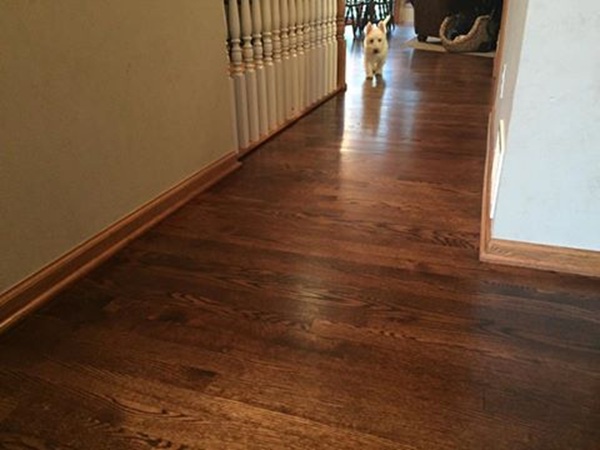
What Refinishing Delivered Here
Sue got what she called about: a clear answer on whether her engineered floor could be sanded, a measured scope, and a finish system matched to a floor that gets daily use. Keeping the existing floor also meant no demolition, no disposal, and no new transitions or trim to work around.
The three-coat build is what carries the floor forward. A sealer coat, two coats of finish, and buffing between each one give the surface a consistent film instead of a thin single pass, and a commercial-grade water-based polyurethane is built for traffic. How long that finish lasts still depends on cleaning habits, pets, grit at the entries, and whether the floor gets a maintenance coat before it wears through again — the same hardwood floor care basics we go over with every refinishing customer. Sue left us a positive review afterward.
Thinking About Refinishing Your Floors?
We've been sanding, staining, and finishing hardwood in the Twin Cities for 26 years, and our sanding crews are our own trained employees, not subcontractors. Plymouth homes keep us busy with exactly this question: can this floor be saved, or does it need to go?
Have a worn, dull, or scratched floor in Plymouth you'd like us to look at? Give us a call or schedule an estimate and we'll come measure it.
Frequently Asked Questions
Can engineered hardwood be sanded and refinished in Plymouth homes?
Sometimes, and it depends on the floor. The wear layer has to be thick enough to take a sanding without cutting through to the core, so we look at the floor in person before quoting the work. On Sue's Plymouth project, we measured 947 square feet and scoped the sand and refinish after seeing what we were working with.
How much dust does a hardwood refinishing job create?
Less than you'd expect, but not none. All of our sanding is done with a dust containment system rated at a 95% effective rate, which pulls the large majority of sanding dust into vacuum containment instead of into your house. We won't promise a dust-free job, and anyone who does is overselling it.
How long before we can walk on the new finish?
Bona Traffic HD, the water-based polyurethane we recommended on this job, fully cures within three days according to the manufacturer. It's also non-yellowing, low in VOCs, and GreenGuard certified, which helps when you're staying in the home during the project. We'll walk you through the cure timeline and furniture handling before the first coat goes down.